Unlock 10% Off Your First Visit!
.svg)
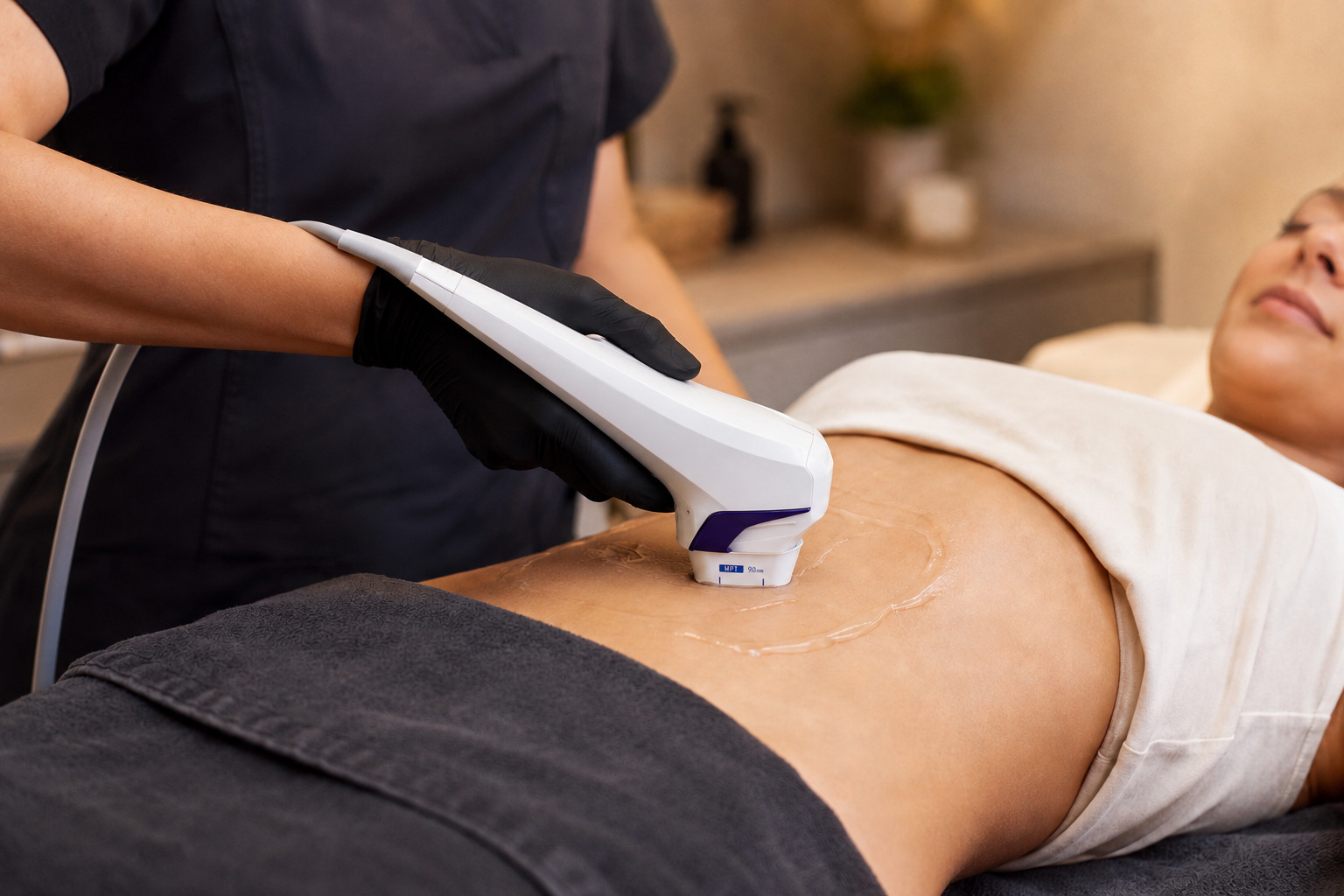
HIFU can be used on the stomach for two main reasons: to improve mild skin laxity and to target small areas of localised fat.
These are two different treatment goals, and understanding the difference is important. Someone concerned about loose skin after weight loss may need a different HIFU approach from someone who is at a stable weight but has a small area of abdominal fat they would like to reduce.
At Skin Studio, we use Ultraformer MPT for both skin tightening and targeted fat reduction. It can produce a worthwhile improvement in the right person, but it is not a weight-loss treatment and cannot remove significant excess skin.
HIFU stands for High-Intensity Focused Ultrasound. It delivers focused ultrasound energy beneath the surface of the skin at controlled depths.
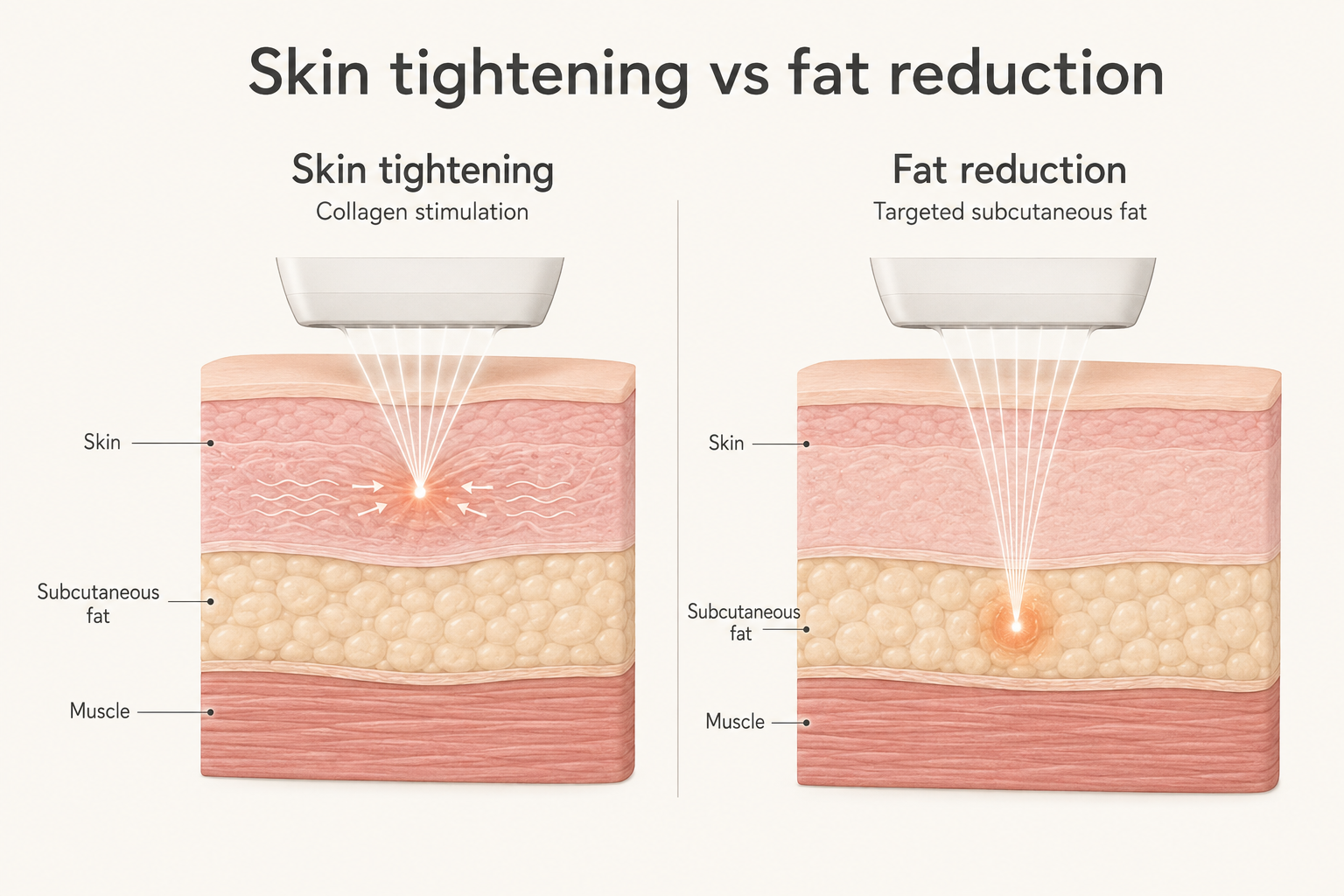
When HIFU is used for skin tightening, the energy creates a controlled response within the tissue that stimulates collagen production and remodelling. As new collagen develops over the following weeks and months, the skin can gradually become firmer and better supported.
When it is used for body contouring, HIFU targets deeper subcutaneous tissue to reduce localised fat. Clinical research has found measurable reductions in abdominal fat thickness and circumference following focused ultrasound treatment in appropriately selected patients. Read the published research on abdominal HIFU fat reduction.
The treatment depth and protocol therefore depend on what we are trying to achieve. This is one reason the consultation and assessment matter as much as the device itself.
If you'd like to understand the technology in more detail, we've explained how HIFU tightens and lifts skin in our dedicated guide.
This is usually the first thing we need to establish.
Mild skin laxity and localised abdominal fat can create a similar appearance, but they are not the same concern. Many people also have a combination of the two.
If your stomach has become slightly looser following ageing or weight changes, stimulating collagen may improve the firmness and quality of the skin.
If you're relatively close to a stable weight but have an area of subcutaneous fat that has been resistant to changes elsewhere in your body, HIFU body contouring may be appropriate.
Where both are contributing to the appearance of the stomach, your doctor can plan treatment accordingly.

Yes, HIFU can be used to reduce localised subcutaneous fat on the stomach when the appropriate body treatment protocol is used.
Focused ultrasound energy targets the fat within the treatment area, after which the body gradually processes the affected tissue. Research into focused ultrasound body contouring has demonstrated measurable reductions in abdominal fat thickness and circumference. See the clinical study.
This is best understood as targeted body contouring rather than weight loss.
HIFU is most relevant when someone is relatively close to a stable weight and wants to improve a specific area. It is not designed to produce substantial changes in overall body weight or replace healthy weight management.
HIFU can also be used to improve mild to moderate skin laxity by stimulating collagen.
Collagen provides much of the structural support within our skin. As collagen levels change with age, weight fluctuations and other factors, the skin can gradually lose some of its firmness.
HIFU encourages collagen remodelling within the treated tissue, so the improvement develops gradually rather than through physically removing or pulling the skin. Research reviews of HIFU have found evidence supporting its use for skin tightening and body contouring. Read the systematic review.
This distinction becomes particularly important when there is significant excess skin. HIFU can improve firmness, but it cannot remove substantial amounts of loose skin in the way an abdominoplasty can.
We take the same approach when discussing facial HIFU. As we explain in HIFU and Facelifts Solve Different Problems, non-surgical and surgical treatments can both be effective when they are being used for the problem they are designed to solve.
Changes in the abdominal area after weight loss or pregnancy can involve skin laxity, changes in fat distribution and, in some cases, changes to the underlying abdominal structures.
HIFU may be suitable when the primary concern is mild skin laxity or localised fat, but it will not be appropriate for every post-pregnancy or post-weight-loss concern.
This is why we assess the area before recommending treatment. If the degree of excess skin is beyond what HIFU can realistically improve, we will tell you.
The same applies following pregnancy. Your doctor will need to establish that you are medically suitable for treatment and that HIFU is appropriate for the particular changes you are experiencing.
The people who tend to be most suitable for stomach HIFU have a relatively specific concern and realistic expectations about the degree of change a non-surgical treatment can produce.
You may be a good candidate if you have:
Age alone does not determine suitability. We look at skin quality, tissue thickness, laxity, fat distribution, general health and what you actually want to achieve.
If your goal is substantial weight loss, removal of significant excess skin or a surgical level of tightening, HIFU is unlikely to be the right treatment.
You can also read more about how to boost collagen in your skin and the role collagen stimulation can play in maintaining skin firmness over time.
Your appointment starts with a doctor-led consultation and assessment of the treatment area.
We look at the tissue and discuss what you would like to change before deciding whether the treatment should focus on skin tightening, fat reduction or both. The stomach is then mapped according to your individual treatment plan.
Ultrasound gel is applied before the Ultraformer MPT handpiece is passed systematically across the area, delivering focused ultrasound at the selected depths.
You will feel the ultrasound energy being delivered. People commonly describe warmth, tingling, short pulses or tenderness, and some areas can feel more sensitive than others. Comfort varies between individuals, so we prefer to explain that honestly rather than describe HIFU as painless.
HIFU is non-surgical and generally requires little interruption to normal activities. Some temporary redness, swelling, tenderness or sensitivity can occur after treatment.
You can find more information about Ultraformer MPT HIFU treatment at Skin Studio.
HIFU results develop gradually because the changes we are trying to create within the tissue take time.
With skin tightening, collagen production and remodelling continue during the weeks and months following treatment. Changes following body contouring also develop progressively as the body processes the targeted tissue.
This means HIFU results should be assessed over time rather than immediately after treatment.
It also makes it important to look critically at HIFU stomach before-and-after photographs. Useful photographs should show the same lighting, posture, camera angle and distance, and should explain how much time passed between images. Changes in body weight and any additional treatments should also be disclosed.
There is no standard number of sessions that makes sense for every stomach.
Someone treating mild laxity has a different starting point from someone treating localised fat. The size of the area, tissue thickness, treatment objective and individual response all affect the plan.
At Skin Studio, we assess your starting point, treat according to the tissue and allow sufficient time for the response to develop before deciding whether further treatment would be beneficial.
The longevity of your result depends partly on what has been treated and what happens to your body afterwards.
Collagen continues to change as part of natural ageing. Weight fluctuations can alter abdominal fat and skin again, and a future pregnancy can naturally change the area significantly.
Maintaining a relatively stable weight is particularly relevant following body contouring. Your doctor can advise on maintenance once your initial result has developed and we can see how your body has responded.
For the right concern and the right person, HIFU can provide a meaningful improvement without surgery.
The key is being clear about what it can realistically achieve. It can improve mild skin laxity, target localised abdominal fat and, in suitable clients, address a combination of both. It cannot produce significant weight loss or remove substantial excess skin.
At Skin Studio, we use Ultraformer MPT and begin every body HIFU treatment with a doctor-led assessment. We'll look at the area properly, explain what we think HIFU can achieve and recommend another approach if we don't think it will give you a worthwhile result.
Not sure whether HIFU is suitable for your stomach? Book a complimentary consultation with one of Skin Studio's doctors for an honest assessment and personalised recommendation.
Yes. HIFU can be used on the abdomen for skin tightening and targeted fat reduction. The treatment approach depends on whether the main concern is skin laxity, localised fat or a combination of both.
HIFU stimulates collagen production and remodelling within the treated tissue, which can gradually improve mild to moderate skin laxity. It cannot physically remove significant amounts of excess skin.
Yes. HIFU can target localised subcutaneous abdominal fat using an appropriate body treatment protocol. It is intended for targeted body contouring rather than overall weight loss.
The number of sessions depends on the treatment objective, size of the area, tissue characteristics and individual response. Your doctor can recommend an appropriate plan after assessing the area.
People commonly experience warmth, tingling, short pulses or tenderness during treatment. Sensitivity varies between individuals and according to the area and treatment depth.
HIFU and an abdominoplasty address very different levels of concern. HIFU can improve mild laxity and localised fat without surgery, while an abdominoplasty can physically remove substantial excess skin and address deeper abdominal structures.
HIFU can be used on the stomach for two main reasons: to improve mild skin laxity and to target small areas of localised fat.
These are two different treatment goals, and understanding the difference is important. Someone concerned about loose skin after weight loss may need a different HIFU approach from someone who is at a stable weight but has a small area of abdominal fat they would like to reduce.
At Skin Studio, we use Ultraformer MPT for both skin tightening and targeted fat reduction. It can produce a worthwhile improvement in the right person, but it is not a weight-loss treatment and cannot remove significant excess skin.
HIFU stands for High-Intensity Focused Ultrasound. It delivers focused ultrasound energy beneath the surface of the skin at controlled depths.
When HIFU is used for skin tightening, the energy creates a controlled response within the tissue that stimulates collagen production and remodelling. As new collagen develops over the following weeks and months, the skin can gradually become firmer and better supported.
When it is used for body contouring, HIFU targets deeper subcutaneous tissue to reduce localised fat. Clinical research has found measurable reductions in abdominal fat thickness and circumference following focused ultrasound treatment in appropriately selected patients. Read the published research on abdominal HIFU fat reduction.
The treatment depth and protocol therefore depend on what we are trying to achieve. This is one reason the consultation and assessment matter as much as the device itself.
If you'd like to understand the technology in more detail, we've explained how HIFU tightens and lifts skin in our dedicated guide.
This is usually the first thing we need to establish.
Mild skin laxity and localised abdominal fat can create a similar appearance, but they are not the same concern. Many people also have a combination of the two.
If your stomach has become slightly looser following ageing or weight changes, stimulating collagen may improve the firmness and quality of the skin.
If you're relatively close to a stable weight but have an area of subcutaneous fat that has been resistant to changes elsewhere in your body, HIFU body contouring may be appropriate.
Where both are contributing to the appearance of the stomach, your doctor can plan treatment accordingly.
Yes, HIFU can be used to reduce localised subcutaneous fat on the stomach when the appropriate body treatment protocol is used.
Focused ultrasound energy targets the fat within the treatment area, after which the body gradually processes the affected tissue. Research into focused ultrasound body contouring has demonstrated measurable reductions in abdominal fat thickness and circumference. See the clinical study.
This is best understood as targeted body contouring rather than weight loss.
HIFU is most relevant when someone is relatively close to a stable weight and wants to improve a specific area. It is not designed to produce substantial changes in overall body weight or replace healthy weight management.
HIFU can also be used to improve mild to moderate skin laxity by stimulating collagen.
Collagen provides much of the structural support within our skin. As collagen levels change with age, weight fluctuations and other factors, the skin can gradually lose some of its firmness.
HIFU encourages collagen remodelling within the treated tissue, so the improvement develops gradually rather than through physically removing or pulling the skin. Research reviews of HIFU have found evidence supporting its use for skin tightening and body contouring. Read the systematic review.
This distinction becomes particularly important when there is significant excess skin. HIFU can improve firmness, but it cannot remove substantial amounts of loose skin in the way an abdominoplasty can.
We take the same approach when discussing facial HIFU. As we explain in HIFU and Facelifts Solve Different Problems, non-surgical and surgical treatments can both be effective when they are being used for the problem they are designed to solve.
Changes in the abdominal area after weight loss or pregnancy can involve skin laxity, changes in fat distribution and, in some cases, changes to the underlying abdominal structures.
HIFU may be suitable when the primary concern is mild skin laxity or localised fat, but it will not be appropriate for every post-pregnancy or post-weight-loss concern.
This is why we assess the area before recommending treatment. If the degree of excess skin is beyond what HIFU can realistically improve, we will tell you.
The same applies following pregnancy. Your doctor will need to establish that you are medically suitable for treatment and that HIFU is appropriate for the particular changes you are experiencing.
The people who tend to be most suitable for stomach HIFU have a relatively specific concern and realistic expectations about the degree of change a non-surgical treatment can produce.
You may be a good candidate if you have:
Age alone does not determine suitability. We look at skin quality, tissue thickness, laxity, fat distribution, general health and what you actually want to achieve.
If your goal is substantial weight loss, removal of significant excess skin or a surgical level of tightening, HIFU is unlikely to be the right treatment.
You can also read more about how to boost collagen in your skin and the role collagen stimulation can play in maintaining skin firmness over time.
Your appointment starts with a doctor-led consultation and assessment of the treatment area.
We look at the tissue and discuss what you would like to change before deciding whether the treatment should focus on skin tightening, fat reduction or both. The stomach is then mapped according to your individual treatment plan.
Ultrasound gel is applied before the Ultraformer MPT handpiece is passed systematically across the area, delivering focused ultrasound at the selected depths.
You will feel the ultrasound energy being delivered. People commonly describe warmth, tingling, short pulses or tenderness, and some areas can feel more sensitive than others. Comfort varies between individuals, so we prefer to explain that honestly rather than describe HIFU as painless.
HIFU is non-surgical and generally requires little interruption to normal activities. Some temporary redness, swelling, tenderness or sensitivity can occur after treatment.
You can find more information about Ultraformer MPT HIFU treatment at Skin Studio.
HIFU results develop gradually because the changes we are trying to create within the tissue take time.
With skin tightening, collagen production and remodelling continue during the weeks and months following treatment. Changes following body contouring also develop progressively as the body processes the targeted tissue.
This means HIFU results should be assessed over time rather than immediately after treatment.
It also makes it important to look critically at HIFU stomach before-and-after photographs. Useful photographs should show the same lighting, posture, camera angle and distance, and should explain how much time passed between images. Changes in body weight and any additional treatments should also be disclosed.
There is no standard number of sessions that makes sense for every stomach.
Someone treating mild laxity has a different starting point from someone treating localised fat. The size of the area, tissue thickness, treatment objective and individual response all affect the plan.
At Skin Studio, we assess your starting point, treat according to the tissue and allow sufficient time for the response to develop before deciding whether further treatment would be beneficial.
The longevity of your result depends partly on what has been treated and what happens to your body afterwards.
Collagen continues to change as part of natural ageing. Weight fluctuations can alter abdominal fat and skin again, and a future pregnancy can naturally change the area significantly.
Maintaining a relatively stable weight is particularly relevant following body contouring. Your doctor can advise on maintenance once your initial result has developed and we can see how your body has responded.
For the right concern and the right person, HIFU can provide a meaningful improvement without surgery.
The key is being clear about what it can realistically achieve. It can improve mild skin laxity, target localised abdominal fat and, in suitable clients, address a combination of both. It cannot produce significant weight loss or remove substantial excess skin.
At Skin Studio, we use Ultraformer MPT and begin every body HIFU treatment with a doctor-led assessment. We'll look at the area properly, explain what we think HIFU can achieve and recommend another approach if we don't think it will give you a worthwhile result.
Not sure whether HIFU is suitable for your stomach? Book a complimentary consultation with one of Skin Studio's doctors for an honest assessment and personalised recommendation.
Yes. HIFU can be used on the abdomen for skin tightening and targeted fat reduction. The treatment approach depends on whether the main concern is skin laxity, localised fat or a combination of both.
HIFU stimulates collagen production and remodelling within the treated tissue, which can gradually improve mild to moderate skin laxity. It cannot physically remove significant amounts of excess skin.
Yes. HIFU can target localised subcutaneous abdominal fat using an appropriate body treatment protocol. It is intended for targeted body contouring rather than overall weight loss.
The number of sessions depends on the treatment objective, size of the area, tissue characteristics and individual response. Your doctor can recommend an appropriate plan after assessing the area.
People commonly experience warmth, tingling, short pulses or tenderness during treatment. Sensitivity varies between individuals and according to the area and treatment depth.
HIFU and an abdominoplasty address very different levels of concern. HIFU can improve mild laxity and localised fat without surgery, while an abdominoplasty can physically remove substantial excess skin and address deeper abdominal structures.
Not sure which treatment is right for you? Book a complimentary consultation and we'll assess your skin, talk through your concerns and recommend what makes sense for you.
Book A Complimentary Skin Consultation
Skin Studio is a doctor-led aesthetics and dermatology clinic in Bali. Our approach is personal, precise and grounded in honest medical advice.
Talk through your concerns and receive clear recommendations, with no pressure to proceed.
Book Your Free ConsultationDiscover Skin Studio →.png)
Discover the perfect balance of how aesthetic treatments can enhance skin health and beauty at Skin Studio Aesthetics. Your beauty journey begins here.


