Unlock 10% Off Your First Visit!
.svg)
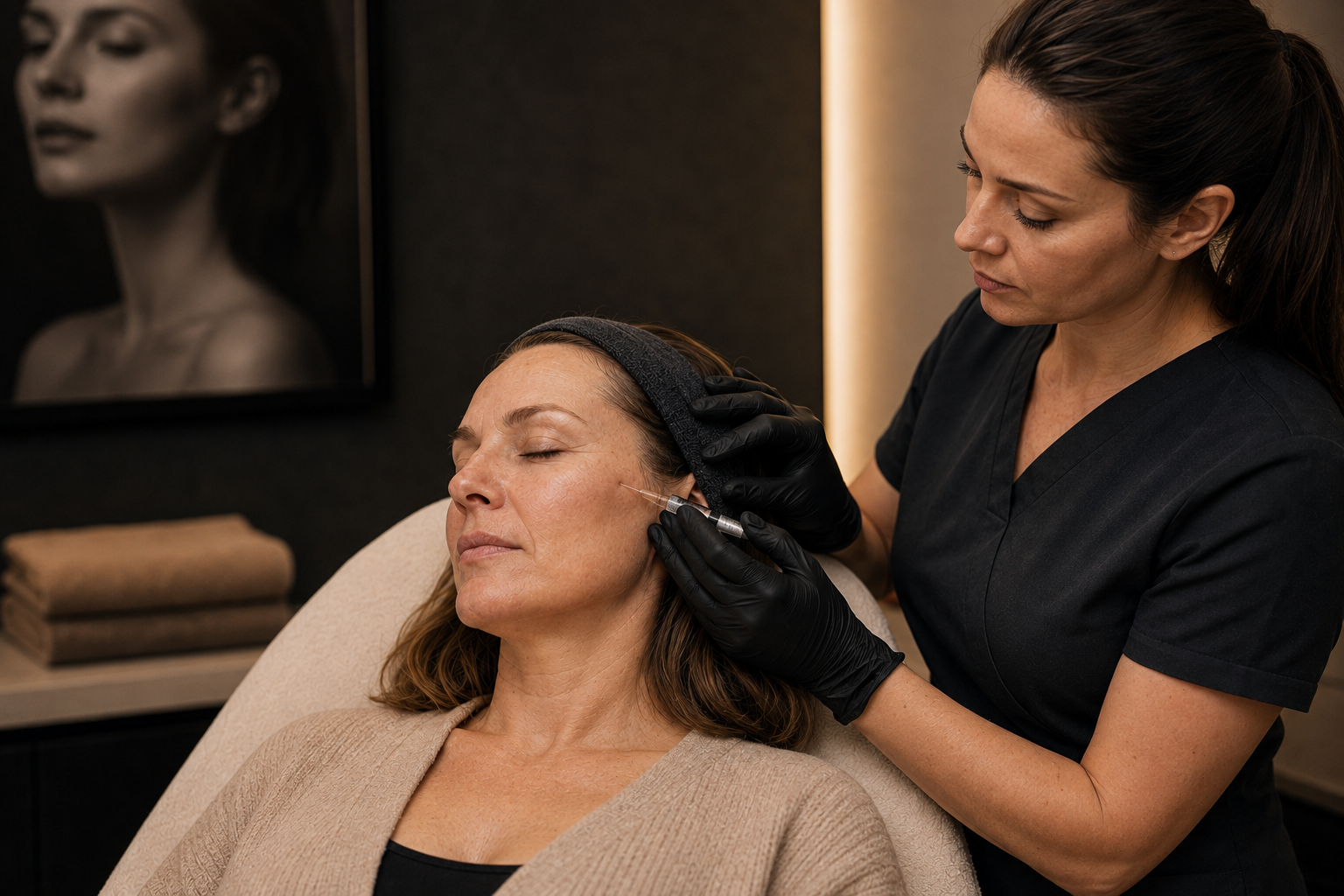
Sculptra is an injectable collagen stimulator designed to help restore some of the structural support our faces gradually lose with age. Its active ingredient, poly-L-lactic acid (PLLA), stimulates your body to produce new collagen, so the result develops progressively rather than being created entirely at the appointment.
This makes Sculptra an interesting option when the concern isn't one particular line, but broader changes in facial volume, firmness and support.
At Skin Studio, Sculptra treatments are planned and performed by our aesthetic doctors. The aim is to understand where your face has changed, where additional collagen support would be useful and whether Sculptra is actually the right treatment for what you want to achieve.
Sculptra is an injectable collagen biostimulator made from poly-L-lactic acid, commonly shortened to PLLA.
Once injected into carefully selected areas, PLLA stimulates a biological response that encourages your body to produce new collagen. That collagen develops over time, gradually improving support and volume within the treated areas.
This is why Scultra results don't appear in their final form immediately after treatment. The treatment begins a process, and your own collagen production does much of the work that follows.
Collagen is one of the proteins responsible for giving our skin and underlying tissue structure and support. As collagen production declines with age, the face can gradually lose some of its firmness and volume.
Sculptra is injected into selected areas where additional structural support is wanted. The PLLA particles stimulate fibroblast activity and new collagen formation around the treated tissue. Over the following weeks and months, that new collagen contributes to a gradual improvement in facial support.
This process is also why Sculptra needs some patience. We aren't trying to create the entire result with the product sitting beneath the skin. We're encouraging your body to build some of that support itself.
If you're interested in the broader role collagen plays in ageing, we've covered how to boost collagen in your skin and how collagen boosters work separately.
Sculptra is an injectable treatment, but it works differently from traditional hyaluronic acid dermal fillers.
A hyaluronic acid filler can be used to add or restore volume directly. This makes filler particularly useful when a doctor wants to create a precise structural change in an area such as the lips, cheeks, chin or jawline.
Sculptra primarily works by stimulating collagen production. Rather than relying on the injected product alone to create the finished result, facial support develops progressively as new collagen forms.
Both treatments have a place in aesthetics. The right choice depends on what has changed in your face and what you would like to improve. Some clients may benefit from Sculptra, some from filler, and for others a combination or entirely different treatment may make more sense.
Sculptra is particularly useful when ageing has created a more general loss of facial support rather than one isolated concern.
Depending on your anatomy and treatment plan, it may be used to improve age-related volume loss, reduced facial support, changes through the cheeks and temples, and overall facial contours.
The result is intended to develop within your existing facial structure. We're looking to improve support and proportion rather than create a different face.
This is also why Sculptra treatment needs to be planned according to the individual. Where collagen has been lost, how facial fat has changed and the underlying bone structure all influence what we're seeing on the surface.
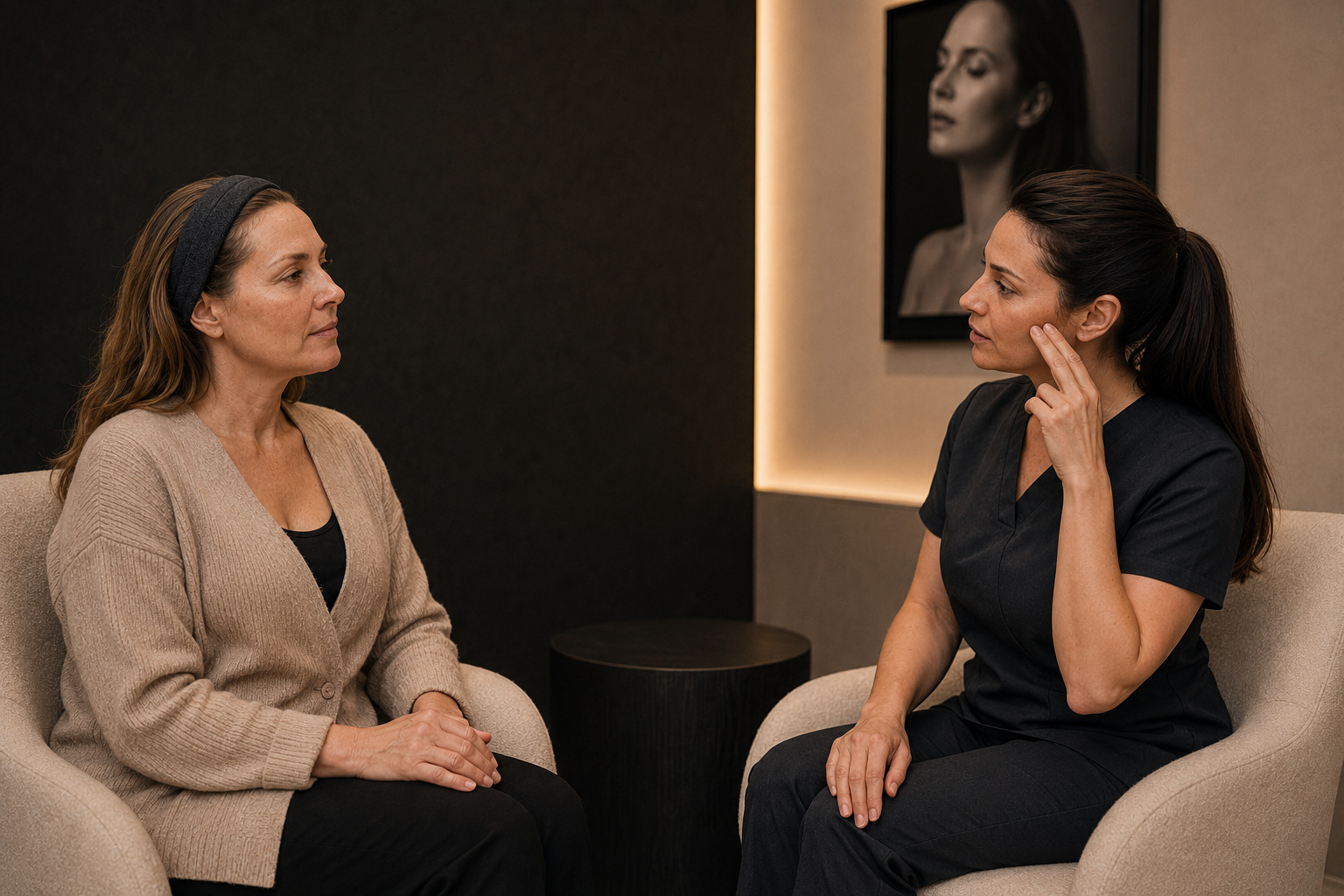
Good Sculptra results develop gradually.
You shouldn't expect to leave your first appointment with the final result. There can be an initial appearance of fullness associated with the treatment itself, but this is separate from the collagen response we're trying to create.
As new collagen develops over the following weeks and months, the face can gradually look better supported, with improvements in volume and contour becoming more apparent.
For many clients, this progressive change is part of Sculptra's appeal. There isn't necessarily one morning when you suddenly look noticeably different. The improvement builds within your own facial structure.
If we use Sculptra before-and-after photographs at Skin Studio, we'll always include the number of treatments and the time elapsed so you're looking at the result in the proper context.
Sculptra results take time because collagen takes time to develop.
The changes become progressively more apparent during the weeks and months following treatment as your body produces new collagen around the treated areas. The exact timeline varies according to your starting point, age, treatment plan and individual collagen response.
This is quite different from choosing a treatment because you need a specific result by next weekend. If we're recommending Sculptra, we're thinking about how your face will look as that collagen develops over the coming months.
Sculptra is commonly planned as a course rather than assuming one appointment will create the full result.
How much treatment you need depends on your age, existing collagen, degree of facial volume loss, areas being treated and the amount of structural improvement we're trying to create.
At Skin Studio, we don't think the useful starting question is how many vials or appointments you can buy. Your doctor first needs to assess your face and understand what you're trying to achieve. From there, we can recommend an appropriate treatment plan and review how your result is developing.
Sculptra is designed to create a longer-term improvement by stimulating your own collagen production.
The result doesn't have a simple expiry date because the collagen produced becomes part of your own tissue, while natural ageing continues in the background. How long the improvement remains visible will vary according to your age, skin quality, treatment course, lifestyle and individual response.
Your doctor can advise on future maintenance once the initial treatment course has developed and we can see how your face has responded.
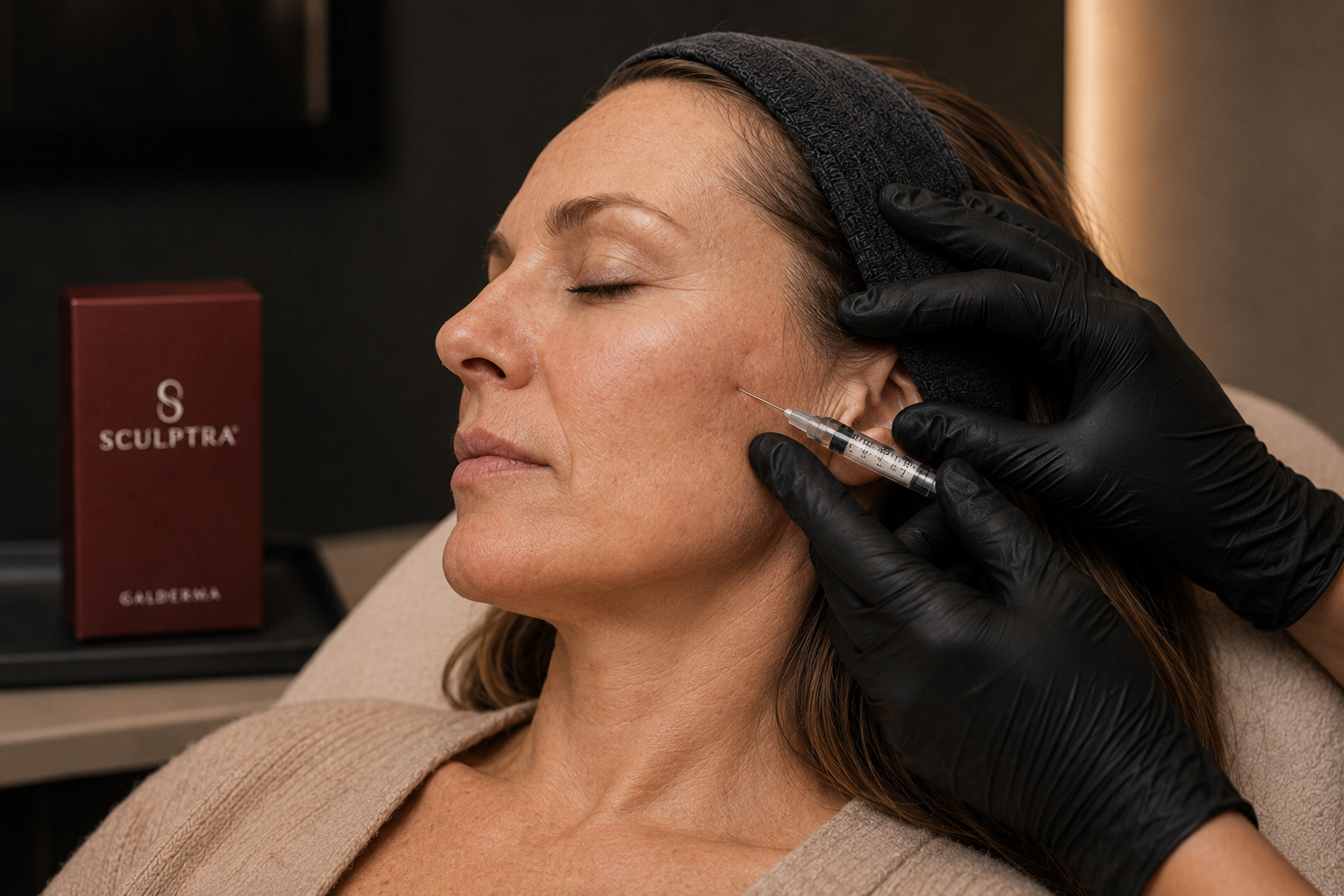
Your Sculptra treatment at Skin Studio starts with a consultation with one of our aesthetic doctors.
We assess your facial structure, existing volume and the areas where support has changed before discussing what Sculptra could realistically achieve. If it's appropriate, your doctor will map and plan the areas to be treated rather than following the same injection pattern for every client.
The product is then injected into the selected areas according to that treatment plan. As with other injectable treatments, some temporary swelling, redness, tenderness or bruising can occur afterwards.
You'll receive specific aftercare instructions before leaving the clinic, along with guidance on when your treatment should be reviewed and whether another session is recommended.
Sculptra is an injectable treatment, so temporary reactions around the injection sites are possible. These can include swelling, redness, tenderness and bruising.
There are also Sculptra-specific risks that your doctor will discuss with you before treatment. This is one reason consultation, correct product preparation, injection technique and appropriate placement matter.
Most people can return to normal daily activities relatively quickly, although your doctor will explain what you should avoid immediately after treatment and any specific aftercare you need to follow.
Sculptra can be particularly useful for people noticing gradual facial volume loss, reduced structural support and broader changes in facial contours associated with ageing.
It also suits people who are comfortable with a result that develops progressively rather than wanting an immediate final change.
Suitability isn't determined by age alone. Two people of the same age can have completely different facial structure, collagen levels, volume loss and treatment goals.
Equally, Sculptra isn't automatically the answer simply because someone wants to stimulate collagen. Skin boosters, microneedling, HIFU, filler and other treatments all work differently, and the best option depends on what we're actually trying to improve.
Sculptra and skin boosters can both be discussed in relation to collagen, but they have different roles.
Skin boosters such as Profhilo, Nucleofill and Rejuran are generally used to improve aspects of skin quality, including hydration, elasticity, repair and, depending on the formulation, collagen activity.
Sculptra is a collagen biostimulator with a greater focus on restoring structural support and volume through new collagen production.
That distinction is important because someone whose main concern is dehydrated, thin or poor-quality skin may need a different treatment from someone experiencing broader facial volume loss.
Neither category is inherently better. They are different tools for different changes in the skin and face.
With Sculptra, the consultation isn't simply about deciding how much product you want.
Your doctor needs to look at your facial anatomy, existing volume, where support has changed and how those changes affect the face as a whole. Treatment placement, amount, timing and the way your collagen response develops all need to be considered.
At Skin Studio, this is the part of aesthetic medicine we think matters most. We have access to a wide range of treatments, so the aim isn't to find a reason to use Sculptra on everyone who asks about it. It's to work out which treatment will actually serve the face in front of us.
Sculptra may be worth considering if you're noticing gradual facial volume loss or reduced structural support and want an improvement that develops progressively through collagen stimulation.
The best way to know is to have your face assessed rather than trying to choose between Sculptra, filler or a skin booster from photographs online.
Interested in what Sculptra could realistically achieve for your face? Book a complimentary consultation with one of Skin Studio's aesthetic doctors for a personalised assessment and treatment recommendation.
Sculptra is an injectable collagen stimulator containing poly-L-lactic acid (PLLA). It stimulates your body's own collagen production, gradually improving facial support and volume in appropriately selected treatment areas.
Sculptra is an injectable biostimulator rather than a traditional hyaluronic acid filler. Hyaluronic acid filler adds volume directly, while Sculptra primarily creates its longer-term effect by stimulating new collagen production.
Sculptra can improve age-related volume loss, reduced structural support and changes in facial contours by stimulating new collagen. The exact areas treated and degree of improvement depend on your facial anatomy and individual treatment plan.
Sculptra works progressively. Collagen production develops during the weeks and months following treatment, so the final result isn't created immediately at the appointment.
Sculptra is designed to create a long-term collagen response, but longevity varies between individuals. Natural ageing continues, and your treatment course, age, skin quality and individual collagen response all influence how long the improvement remains visible.
Sculptra is commonly planned as a course, but there is no universal number that suits everyone. Your doctor will consider your degree of volume loss, facial anatomy, age, treatment areas and desired result before recommending a plan.
Sculptra results develop through your own collagen production, allowing improvements in support and volume to emerge progressively within your existing facial structure. Good treatment planning is important to achieving a balanced result.
Temporary swelling, redness, tenderness and bruising can occur following Sculptra injections. There are also less common treatment-specific risks, which your doctor should discuss with you during consultation before you decide whether to proceed.
Neither treatment is universally better. Sculptra stimulates collagen to create progressive structural support, while hyaluronic acid filler can add or restore volume directly. The appropriate choice depends on your anatomy, concern and the result you're trying to achieve.
Sculptra is an injectable collagen stimulator designed to help restore some of the structural support our faces gradually lose with age. Its active ingredient, poly-L-lactic acid (PLLA), stimulates your body to produce new collagen, so the result develops progressively rather than being created entirely at the appointment.
This makes Sculptra an interesting option when the concern isn't one particular line, but broader changes in facial volume, firmness and support.
At Skin Studio, Sculptra treatments are planned and performed by our aesthetic doctors. The aim is to understand where your face has changed, where additional collagen support would be useful and whether Sculptra is actually the right treatment for what you want to achieve.
Sculptra is an injectable collagen biostimulator made from poly-L-lactic acid, commonly shortened to PLLA.
Once injected into carefully selected areas, PLLA stimulates a biological response that encourages your body to produce new collagen. That collagen develops over time, gradually improving support and volume within the treated areas.
This is why Scultra results don't appear in their final form immediately after treatment. The treatment begins a process, and your own collagen production does much of the work that follows.
Collagen is one of the proteins responsible for giving our skin and underlying tissue structure and support. As collagen production declines with age, the face can gradually lose some of its firmness and volume.
Sculptra is injected into selected areas where additional structural support is wanted. The PLLA particles stimulate fibroblast activity and new collagen formation around the treated tissue. Over the following weeks and months, that new collagen contributes to a gradual improvement in facial support.
This process is also why Sculptra needs some patience. We aren't trying to create the entire result with the product sitting beneath the skin. We're encouraging your body to build some of that support itself.
If you're interested in the broader role collagen plays in ageing, we've covered how to boost collagen in your skin and how collagen boosters work separately.
Sculptra is an injectable treatment, but it works differently from traditional hyaluronic acid dermal fillers.
A hyaluronic acid filler can be used to add or restore volume directly. This makes filler particularly useful when a doctor wants to create a precise structural change in an area such as the lips, cheeks, chin or jawline.
Sculptra primarily works by stimulating collagen production. Rather than relying on the injected product alone to create the finished result, facial support develops progressively as new collagen forms.
Both treatments have a place in aesthetics. The right choice depends on what has changed in your face and what you would like to improve. Some clients may benefit from Sculptra, some from filler, and for others a combination or entirely different treatment may make more sense.
Sculptra is particularly useful when ageing has created a more general loss of facial support rather than one isolated concern.
Depending on your anatomy and treatment plan, it may be used to improve age-related volume loss, reduced facial support, changes through the cheeks and temples, and overall facial contours.
The result is intended to develop within your existing facial structure. We're looking to improve support and proportion rather than create a different face.
This is also why Sculptra treatment needs to be planned according to the individual. Where collagen has been lost, how facial fat has changed and the underlying bone structure all influence what we're seeing on the surface.
Good Sculptra results develop gradually.
You shouldn't expect to leave your first appointment with the final result. There can be an initial appearance of fullness associated with the treatment itself, but this is separate from the collagen response we're trying to create.
As new collagen develops over the following weeks and months, the face can gradually look better supported, with improvements in volume and contour becoming more apparent.
For many clients, this progressive change is part of Sculptra's appeal. There isn't necessarily one morning when you suddenly look noticeably different. The improvement builds within your own facial structure.
If we use Sculptra before-and-after photographs at Skin Studio, we'll always include the number of treatments and the time elapsed so you're looking at the result in the proper context.
Sculptra results take time because collagen takes time to develop.
The changes become progressively more apparent during the weeks and months following treatment as your body produces new collagen around the treated areas. The exact timeline varies according to your starting point, age, treatment plan and individual collagen response.
This is quite different from choosing a treatment because you need a specific result by next weekend. If we're recommending Sculptra, we're thinking about how your face will look as that collagen develops over the coming months.
Sculptra is commonly planned as a course rather than assuming one appointment will create the full result.
How much treatment you need depends on your age, existing collagen, degree of facial volume loss, areas being treated and the amount of structural improvement we're trying to create.
At Skin Studio, we don't think the useful starting question is how many vials or appointments you can buy. Your doctor first needs to assess your face and understand what you're trying to achieve. From there, we can recommend an appropriate treatment plan and review how your result is developing.
Sculptra is designed to create a longer-term improvement by stimulating your own collagen production.
The result doesn't have a simple expiry date because the collagen produced becomes part of your own tissue, while natural ageing continues in the background. How long the improvement remains visible will vary according to your age, skin quality, treatment course, lifestyle and individual response.
Your doctor can advise on future maintenance once the initial treatment course has developed and we can see how your face has responded.
Your Sculptra treatment at Skin Studio starts with a consultation with one of our aesthetic doctors.
We assess your facial structure, existing volume and the areas where support has changed before discussing what Sculptra could realistically achieve. If it's appropriate, your doctor will map and plan the areas to be treated rather than following the same injection pattern for every client.
The product is then injected into the selected areas according to that treatment plan. As with other injectable treatments, some temporary swelling, redness, tenderness or bruising can occur afterwards.
You'll receive specific aftercare instructions before leaving the clinic, along with guidance on when your treatment should be reviewed and whether another session is recommended.
Sculptra is an injectable treatment, so temporary reactions around the injection sites are possible. These can include swelling, redness, tenderness and bruising.
There are also Sculptra-specific risks that your doctor will discuss with you before treatment. This is one reason consultation, correct product preparation, injection technique and appropriate placement matter.
Most people can return to normal daily activities relatively quickly, although your doctor will explain what you should avoid immediately after treatment and any specific aftercare you need to follow.
Sculptra can be particularly useful for people noticing gradual facial volume loss, reduced structural support and broader changes in facial contours associated with ageing.
It also suits people who are comfortable with a result that develops progressively rather than wanting an immediate final change.
Suitability isn't determined by age alone. Two people of the same age can have completely different facial structure, collagen levels, volume loss and treatment goals.
Equally, Sculptra isn't automatically the answer simply because someone wants to stimulate collagen. Skin boosters, microneedling, HIFU, filler and other treatments all work differently, and the best option depends on what we're actually trying to improve.
Sculptra and skin boosters can both be discussed in relation to collagen, but they have different roles.
Skin boosters such as Profhilo, Nucleofill and Rejuran are generally used to improve aspects of skin quality, including hydration, elasticity, repair and, depending on the formulation, collagen activity.
Sculptra is a collagen biostimulator with a greater focus on restoring structural support and volume through new collagen production.
That distinction is important because someone whose main concern is dehydrated, thin or poor-quality skin may need a different treatment from someone experiencing broader facial volume loss.
Neither category is inherently better. They are different tools for different changes in the skin and face.
With Sculptra, the consultation isn't simply about deciding how much product you want.
Your doctor needs to look at your facial anatomy, existing volume, where support has changed and how those changes affect the face as a whole. Treatment placement, amount, timing and the way your collagen response develops all need to be considered.
At Skin Studio, this is the part of aesthetic medicine we think matters most. We have access to a wide range of treatments, so the aim isn't to find a reason to use Sculptra on everyone who asks about it. It's to work out which treatment will actually serve the face in front of us.
Sculptra may be worth considering if you're noticing gradual facial volume loss or reduced structural support and want an improvement that develops progressively through collagen stimulation.
The best way to know is to have your face assessed rather than trying to choose between Sculptra, filler or a skin booster from photographs online.
Interested in what Sculptra could realistically achieve for your face? Book a complimentary consultation with one of Skin Studio's aesthetic doctors for a personalised assessment and treatment recommendation.
Sculptra is an injectable collagen stimulator containing poly-L-lactic acid (PLLA). It stimulates your body's own collagen production, gradually improving facial support and volume in appropriately selected treatment areas.
Sculptra is an injectable biostimulator rather than a traditional hyaluronic acid filler. Hyaluronic acid filler adds volume directly, while Sculptra primarily creates its longer-term effect by stimulating new collagen production.
Sculptra can improve age-related volume loss, reduced structural support and changes in facial contours by stimulating new collagen. The exact areas treated and degree of improvement depend on your facial anatomy and individual treatment plan.
Sculptra works progressively. Collagen production develops during the weeks and months following treatment, so the final result isn't created immediately at the appointment.
Sculptra is designed to create a long-term collagen response, but longevity varies between individuals. Natural ageing continues, and your treatment course, age, skin quality and individual collagen response all influence how long the improvement remains visible.
Sculptra is commonly planned as a course, but there is no universal number that suits everyone. Your doctor will consider your degree of volume loss, facial anatomy, age, treatment areas and desired result before recommending a plan.
Sculptra results develop through your own collagen production, allowing improvements in support and volume to emerge progressively within your existing facial structure. Good treatment planning is important to achieving a balanced result.
Temporary swelling, redness, tenderness and bruising can occur following Sculptra injections. There are also less common treatment-specific risks, which your doctor should discuss with you during consultation before you decide whether to proceed.
Neither treatment is universally better. Sculptra stimulates collagen to create progressive structural support, while hyaluronic acid filler can add or restore volume directly. The appropriate choice depends on your anatomy, concern and the result you're trying to achieve.

Not sure which treatment is right for you? Book a complimentary consultation and we'll assess your skin, talk through your concerns and recommend what makes sense for you.
Book A Complimentary Skin Consultation
Skin Studio is a doctor-led aesthetics and dermatology clinic in Bali. Our approach is personal, precise and grounded in honest medical advice.
Talk through your concerns and receive clear recommendations, with no pressure to proceed.
Book Your Free ConsultationDiscover Skin Studio →.png)
Discover the perfect balance of how aesthetic treatments can enhance skin health and beauty at Skin Studio Aesthetics. Your beauty journey begins here.


